In business operations, compliance with tax obligations is not only a legal responsibility but also a key indicator of a company’s transparency and credibility. However, in practice, many enterprises still commit tax violations, ranging from misreporting and late payment to tax evasion and repeated offenses. Such acts not only lead to administrative sanctions and tax arrears collection but may also result in the revocation of the enterprise registration certificate in accordance with the law. So, in which cases for enterprises revoked for tax violations, and what are the legal consequences?
I. Current situation of enterprises revoked due to tax violations
In recent years, tax law violations by enterprises have become increasingly common, affecting entities from small enterprises to large corporations.
Many enterprises intentionally make false declarations, evade taxes, pay taxes late, or fail to pay taxes within the prescribed duration. In addition, some cases result from legal ignorance, errors in declarations, or weaknesses in accounting and management systems.
According to tax authority statistics, thousands of enterprises are administratively sanctioned and subject to tax enforcement measures every year, and a significant number have their enterprise registration certificates revoked.

In particular, “virtual” companies established solely to issue fake invoices, fraudulently claim tax refunds, or those that abandon their business addresses and fail to fulfill tax obligations for a long period account for a large proportion of revoked entities.
This situation not only causes losses to the State budget but also creates a non-transparent business environment, leading to unfair competition between law-abiding and non-compliant enterprises.
Therefore, the strict handling and revocation of enterprise registration certificates for tax-violating entities are necessary measures to restore discipline and order in tax administration and business activities.
II. Legal provisions on enterprises subject to revocation due to tax violations
Vietnamese law has established detailed provisions regarding enterprises’ tax obligations and the corresponding sanctions for violations. Among these measures, the revocation of the Enterprise Registration Certificate represents the most severe form of sanction, serving as a strong deterrent for serious, prolonged, or repeated tax violations.
1. What is an enterprise revoked due to tax violations?
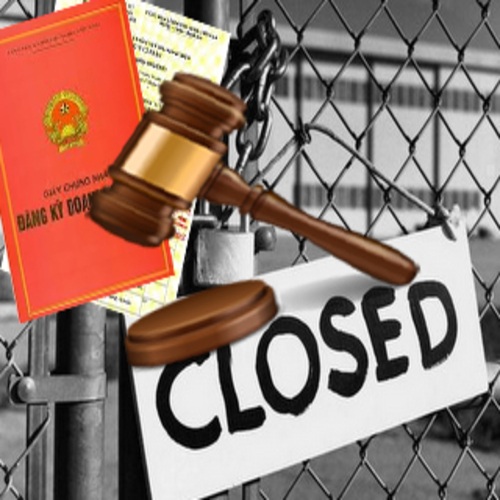
An enterprise revoked due to tax violations refers to the case in which the business registration authority issues a decision to invalidate the enterprise registration certificate due to the enterprise’s breach of tax obligations under the law. It means the enterprise no longer has legal capacity to continue operating.
2. In what cases may an enterprise be revoked for tax violations under current regulations?
Under Clause 1, Article 125 of the Law on Tax Administration 2019, one of the coercive enforcement measures for administrative decisions on tax management is the revocation of enterprise registration certificates, business registration certificates, cooperative registration certificates, investment registration certificates, establishment and operation licenses, or practicing licenses.

According to Clause 1, Article 37 of Decree No. 126/2020/NĐ-CP, the enforcement measure of revoking enterprise registration certificates, business registration certificates, cooperative registration certificates, investment registration certificates, establishment and operation licenses, practicing licenses, or branch/representative office registration certificates is applied when the tax authority cannot implement other enforcement measures specified at Points a, b, c, d, đ, e Clause 1 Article 125 of the Law on Tax Administration, or when those measures have been applied but the tax debt has not been fully recovered, or in cases stipulated under Clause 3 Article 125 of this Law.
Accordingly, if an enterprise violates tax laws and fails to comply with administrative tax decisions, the revocation of its enterprise registration certificate may be imposed as an enforcement measure.
3. What are the legal consequences when an enterprise is revoked due to tax violations?
When a competent state authority issues a decision to revoke an enterprise’s registration certificate due to tax violations, the enterprise will take serious legal consequences, including:
- Termination of legal status: Under Clause 3, Article 37 of Decree No. 126/2020/NĐ-CP, within 10 days from the date of receiving the tax authority’s revocation request, the business registration authority must revoke the enterprise registration certificate. Once revoked, the enterprise loses its legal capacity and is no longer allowed to conduct business activities.
- Mandatory dissolution procedure: After revocation, the enterprise must proceed with dissolution procedures under Point d, Clause 1, Article 207 of the Law on Enterprise 2020, including debt settlement obligations, particularly tax liabilities to the State.
- Tax risk monitoring: The tax authority may classify the enterprise as a tax-risk entity, restricting its ability to establish new enterprises or subjecting it to stricter monitoring in future operations.
- Impact on reputation and related transactions: Revocation due to tax violations can severely damage the enterprise’s reputation, affect partner and customer trust, and hinder access to credit or investment opportunities.
III. Questions on enterprises being revoked for tax violations
1. Can an enterprise revoked for tax violations resume its operations?
Once an enterprise’s registration certificate is revoked, its legal status is terminated, and it is no longer permitted to operate. Current laws do not provide for reinstatement procedures after revocation, except in cases where the enterprise proves that the revocation decision was unlawful and obtains an annulment from a competent authority.
2. Can an enterprise revoked for tax violations transfer its assets?
Following revocation, the enterprise must implement dissolution procedures in accordance with Article 209 of the Law on Enterprise 2020. During such a process, the enterprise may liquidate or transfer assets to settle outstanding obligations, including tax debts, employee wages, and debts to partners.
3. Can an enterprise file a lawsuit against the revocation decision?
According to Article 148 of the Law on Tax Administration 2019, lawsuits against administrative decisions or acts of tax authorities and officials shall comply with the Law on Administrative Procedures 2015.

If an enterprise believes the revocation decision is unlawful, it may file a complaint under the Law on Complaints 2011 or initiate an administrative lawsuit to request the Court to annul the decision.
4. How are outstanding financial obligations of a revoked enterprise handled?
Under Clause 3, Article 209 of the Law on Enterprise 2020 (as amended in 2025), despite revocation, the enterprise remains responsible for settling any outstanding financial obligations. The legal representative, members, or shareholders must jointly take responsibility for settling debts, particularly tax liabilities owed to the State.
5. How is the corporate seal of a revoked enterprise handled?
When an enterprise is revoked for tax violations, its corporate seal must be surrendered or destroyed in accordance with the law: Seals issued by the police shall be confiscated, while self-made seals must be destroyed during the dissolution process.
IV. Legal consultancy services related to enterprises revoked for tax violations
Revocation due to tax violations not only causes economic losses but also results in complex legal consequences. To safeguard legitimate interests and mitigate risks, seeking assistance from legal professionals is essential. Legal consultancy services may include:
- Advising, reviewing, and assessing the causes leading to revocation to determine legal responsibility and appropriate remedies;
- Representing enterprises in working with tax authorities and business registration agencies to explain, request extensions, or adjust obligations prior to enforcement;
- Assisting with complaints or administrative lawsuits if the revocation decision is deemed unlawful;
- Advising on dissolution procedures after revocation, including settlement of tax debts, employee obligations, and liabilities to the State;
- Guiding the handling of corporate seals, legal documents, and assets to ensure compliance and prevent disputes.
For any inquiries or legal support regarding enterprises revoked for tax violations, please contact NPLAW for direct consultation and professional guidance.