Invoices are important documents in business activities, reflecting transactions for the sale of goods and provision of services, and serving as the basis for tax declaration, deduction, and refund. However, in practice, the issuance of fake invoices and the trading of invoices have become increasingly sophisticated and widespread, causing losses to the State budget, distorting the business market, and posing significant legal risks to related organizations and individuals. So how is the issuance of fake invoices sanctioned? Below, NPLaw provides consultation and clarification for Clients.
I. Current situation of fake invoice issuance
At present, the issuance of fake invoices has become a pressing issue in tax administration and corporate finance management in Vietnam. According to statistics from tax authorities and law enforcement agencies, cases involving the illegal purchase, sale, and use of invoices have continuously increased in both number and scale, with increasingly sophisticated and organized methods.

Violators often establish shell companies with no actual business operations for the purpose of issuing fictitious invoices, enabling other enterprises to declare non-existent expenses to evade taxes, unlawfully appropriate value-added tax (VAT) refunds, or withdraw cash illegally. In addition, there has been the emergence of using software to create fake invoices, alter invoice information, or impersonate legitimate enterprises to legitimize transactions.
Of particular concern is that some enterprises inadvertently use fake invoices, thereby facing administrative sanctions, tax arrears recovery, or even criminal prosecution, although they don’t intentionally commit fraud, due to a lack of legal knowledge or reliance on partners of unclear origin.
II. Legal regulations on the issuance of fake invoices
1. What constitutes the issuance of fake invoices?
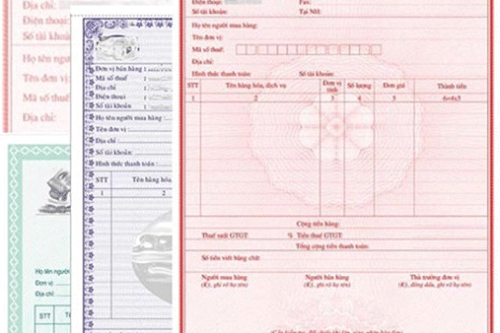
Pursuant to Clause 8, Article 3 of Decree No. 123/2020/NĐ-CP: Fake invoices and documents are invoices or documents printed or created according to the invoice or document templates that have been notified for issuance by another organization or individual, or printed or created with duplicate numbers of the same invoice or document symbol, or electronic invoices or electronic documents that are forged.
Accordingly, fake invoices are invoices printed or created using invoice templates that have been notified for issuance by another organization or individual, or invoices printed or created with duplicate numbers under the same invoice symbol, or forged electronic invoices.
2. How is the issuance of fake invoices administratively sanctioned?
Pursuant to Clause 1, Article 28 and Article 24 of Decree No. 125/2020/NĐ-CP, the use of fake invoices is considered the use of unlawful invoices and may be subject to administrative fines ranging from 20,000,000 VND to 50,000,000 VND.
However, the above fine does not apply in cases where fake invoices are used for the following purposes:
- For accounting the value of purchased goods or services in order to reduce the amount of tax payable or increase the amount of tax refunded, exempted, or reduced, but upon inspection or audit by tax authorities, the purchaser proves that the fault in using unlawful invoices or documents lies with the seller, and the purchaser has fully recorded accounting entries in accordance with regulations.

In such cases, the violation may be fined at 20% of the understated tax amount or the amount of tax exempted, reduced, or refunded in excess of regulations.
- For tax declaration purposes to reduce the amount of tax payable or increase the amount of tax refunded, exempted, or reduced.
Such an act may be subject to a fine equal to one (01) time the evaded tax amount for taxpayers with one or more mitigating circumstances.
3. What criminal liabilities may arise from issuing fake invoices?
In serious cases, acts related to the use of fake or fictitious invoices may be subject to criminal prosecution under the Penal Code 2015, as amended and supplemented in 2017.
- Possible charges: Tax evasion, forging seals or documents of agencies or organizations.
- Sanctions: Violators may be subject to monetary fines or imprisonment depending on the severity of the violation. In serious and organized cases, imprisonment may be imposed for up to 10 years.
- Additional sanctions: These may include prohibition from holding certain positions, or practicing certain professions, or confiscation of assets in particularly serious cases.
III. Certain questions related to fake invoice issuance
1. How is the issuance of fake invoices resulting in a reduction of tax payable sanctioned?
Pursuant to Point d, Clause 1, Article 17 of Decree No. 125/2020/NĐ-CP, the use of unlawful invoices or the unlawful use of invoices for tax declaration to reduce the amount of tax payable or increase the amount of tax refunded, exempted, or reduced shall be subject to a fine equal to one (01) time the evaded tax amount for taxpayers with one or more mitigating circumstances.
2. How is a commercial legal entity sanctioned for issuing fake invoices?
Pursuant to Article 24 and Clause 1, Article 28 of Decree No. 125/2020/NĐ-CP, the use of fake invoices is considered the use of unlawful invoices and may be subject to administrative fines ranging from 20,000,000 VND to 50,000,000 VND.
For the same administrative violation related to taxation or invoices, an organization shall be imposed the fine as twice as an individual.
3. From what amount does the issuance of fake invoices result in criminal liability?
Under Article 203 of the Penal Code 2015, as amended in 2017, the issuance of fake invoices may result in criminal liability for the offense of illegally printing, issuing, or trading invoices or documents for State budget revenues when all constituent elements of the crime are satisfied.

Any person who illegally prints, issues, or trades invoice forms numbering from 50 to under 100 copies, or invoices or documents with recorded contents numbering from 10 to under 30 copies, or who gains illegal profits ranging from 30,000,000 VND to under 100,000,000 VND, shall be subject to a fine from 50,000,000 VND to 200,000,000 VND, non-custodial reform for up to 03 years, or imprisonment from 06 months to 03 years.
Accordingly, the issuance of fake invoices resulting in illegal profits of 30,000,000 VND or more may result in criminal prosecution.
IV. Advisory services related to fake invoice issuance
The above constitutes the comprehensive information provided by NPLaw to support our valued clients regarding issues related to fake invoice issuance. Should you have any further questions concerning the above matters or other legal issues, please contact NPLaw for direct consultation and guidance.