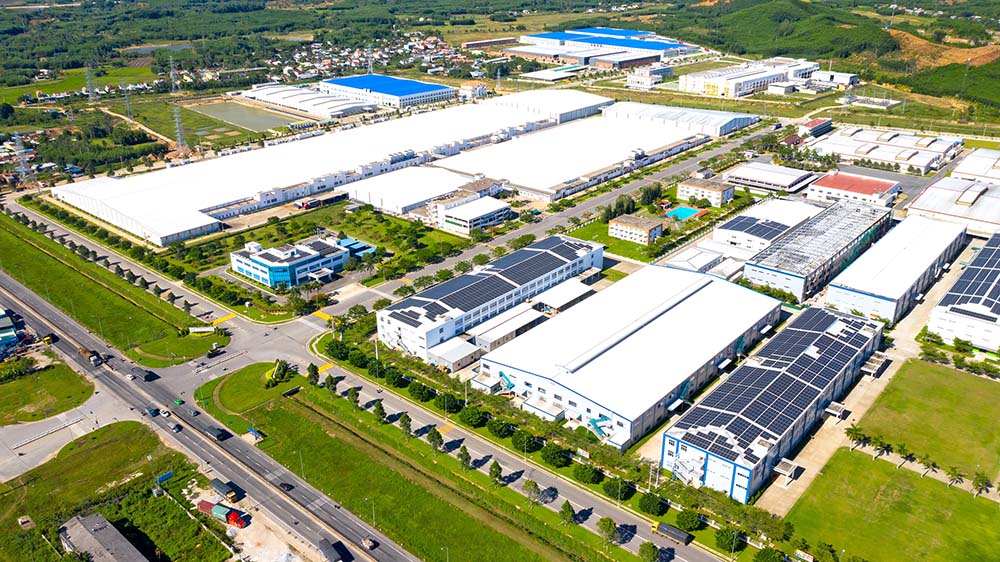
Industrial parks play a crucial role in attracting investment capital, promoting economic development, and creating jobs for workers. Investment projects in industrial parks not only help enterprises access synchronized infrastructure and attractive incentive policies, but also contribute to enhancing production capacity and competitiveness in the market. Below, NPLaw invites readers to explore the legal issues related to investment projects in industrial parks.
I. Overview of investment projects in industrial parks
Investment projects in industrial parks play an important role in driving economic growth, attracting domestic and foreign investment capital, and creating favorable conditions for production and business activities of enterprises. Industrial parks are often planned with synchronized infrastructure, attractive incentive policies, and a favorable legal environment to attract investors into key industries.
However, investment projects in industrial parks must comply with legal regulations on business sectors, environmental protection, land use, and labor. Additionally, depending on each industrial park, investors may be restricted from certain industries to ensure sustainable development orientations. In general, investing in industrial parks brings many advantages but also requires enterprises to strictly comply with regulations to ensure effective and long-term operations.
II. Legal regulations on investment projects in industrial parks
1. What is an investment project in an industrial park?
An investment project in an industrial park is an investment activity carried out within the scope of an industrial park, an area planned and developed specifically for industrial production, processing, manufacturing, or supporting production services.
2. Procedures for establishing an investment project in an industrial park
Step 1: Prepare the investment licensing dossier
According to Clause 1 Article 31 of Decree 31/2021/ND-CP and Clause 1 Article 33 of the Law on Investment 2020, the dossier includes:
- A written request for implementation of the investment project, with a commitment to take responsibility if the project is not approved;
- Legal documents of the investor (enterprise registration certificate, passport, etc.);
- Proof of financial capacity: financial statements for the last 2 years, financial support commitments from the parent company or financial institutions, etc.;
- Investment project proposal, including objectives, scale, investment capital, location, implementation schedule, land use needs, labor needs, environmental impact assessment, etc.;
- Pre-feasibility study report (if required by law);
- Documents proving land use rights (if not requesting the State to allocate or lease land);
- Technology explanation (if subject to appraisal);
- BCC contract (if investing under a BCC contract);
- Other documents as prescribed by law (if any).
Step 2: Submit the investment licensing dossier
- Submit the dossier to the Department of Planning and Investment or the Management Board of the economic zone depending on the scale of the project.
- Time to issue the Investment Registration Certificate: 05 working days from the date of receiving a complete and valid dossier.
- For projects under the authority to approve investment policies of multiple provinces, the Prime Minister assigns a suitable investment registration agency to issue the certificate.
Step 3: Receive results
- If the dossier is valid, the competent authority will issue the Investment Registration Certificate.
- If the conditions are not met, the investor will receive a notice to supplement or adjust the dossier.
3. Forms of incentives for investment projects in industrial parks
According to Clause 1, Article 15 of the Law on Investment 2020, investment projects in industrial parks enjoy the following investment incentives:
- Corporate income tax incentives;
- Import tax exemption;
- Exemption or reduction of land use fees, land rent, land use tax;
- Accelerated depreciation, increased deductible expenses when calculating corporate income tax.
Thus, investment projects in industrial parks benefit from many tax, land, and financial incentive policies, helping reduce costs and increase competitiveness.
III. Questions on investment projects in industrial parks
1. Do investment projects in industrial parks enjoy investment incentives?
According to point b, Clause 2, Article 15 of the Law on Investment 2020, subjects entitled to investment incentives include projects implemented in investment incentive areas specified in Clause 2, Article 16 of the Law on Investment 2020. Specifically, investment incentive areas include: areas with difficult socio-economic conditions, areas with especially difficult socio-economic conditions, industrial parks, export processing zones, hi-tech zones, and economic zones.
Thus, investment projects implemented in industrial parks will enjoy investment incentives if such industrial parks are located in areas listed as investment incentive areas.
2. Are investment projects in industrial parks restricted in business sectors?
Investment projects in industrial parks may be restricted in business sectors depending on the law and development orientation of each industrial park. According to Articles 6 and 7 of the Law on Investment 2020, prohibited business sectors include those likely to affect national defense, security, environment, and public health, such as drug production, human trafficking, prostitution, or trading in human body parts.
In addition, according to Article 9 of the Law on Investment 2020, foreign investors are subject to market access conditions like domestic investors, except for sectors on the list of market access restrictions for foreign investors. These may include telecommunications services, press, publishing, exploitation of natural resources, etc., where foreign investors must meet special conditions or are not allowed to participate.
Thus, investment projects in industrial parks may be restricted in business sectors if they fall under the prohibited, conditional sectors, or are inconsistent with the industrial park’s development plan.
3. How long does it take to obtain a license for an investment project in an industrial park?
According to Articles 30, 31, and 32 of the Law on Investment 2020, large-scale projects or projects in sectors affecting security, national defense, and the environment must obtain investment policy approval from the National Assembly, the Prime Minister, or the Provincial People’s Committee. The consideration and approval period for these projects ranges from 30 to 90 days depending on the approving level.
If the project does not fall under the category requiring investment policy approval, the investor only needs to carry out procedures to obtain the Investment Registration Certificate. According to Article 38 of the Law on Investment 2020, the investment registration agency must issue the certificate within 15 working days from the date of receiving a complete and valid dossier.
4. Can an investment project in an industrial park be revoked if it fails to meet the implementation schedule?
According to Clause 2, Article 48 of the Law on Investment 2020, an investment project in an industrial park may be revoked if, after 12 months from the date of issuance of the Investment Registration Certificate, the investor does not implement the project or implements it behind schedule without a valid reason, and the competent authority may decide to terminate the project.
Thus, an investment project in an industrial park may be revoked if it fails to meet the schedule without a legitimate reason. Investors need to monitor and implement the project as committed to avoid revocation under the law.
5. Can foreign investors implement investment projects in industrial parks?
According to Clause 1, Article 37 of the Law on Investment 2020, foreign investors are completely allowed to implement investment projects in industrial parks but must comply with the procedures for obtaining the Investment Registration Certificate before proceeding with subsequent steps. Specifically, investment projects by foreign investors or economic organizations with foreign investment capital are required to carry out procedures to obtain the Investment Registration Certificate. Only after obtaining this certificate can the investor proceed with enterprise registration procedures to establish a company and implement business activities in the industrial park.
Thus, foreign investors can implement investment projects in industrial parks, but must first obtain the Investment Registration Certificate.
IV. Legal consulting services related to investment projects in industrial parks
Above is NPLaw’s article on investment projects in industrial parks. With a team of experienced lawyers and legal specialists, NPLaw is always ready to accompany, advise, and support clients on legal issues related to investment projects in industrial parks. For assistance with other legal matters, please contact NPLaw using the following information: