I. Overview of the transferee of a bill of exchange
The transferee of a bill of exchange is an individual or organization to whom ownership and the right to enjoy the amount stated on the bill are transferred. Such transfer may be effected through endorsement or in accordance with contractual arrangements.
II. Legal regulations governing the transferee of a bill of exchange
1. Rights and obligations of the transferee
Pursuant to Articles 17 and 21 of the Law on Negotiable Instruments 2005:

Rights of the transferee:
- To demand payment of the amount stated on the bill upon maturity;
- To further transfer the bill to a third party if lawfully entitled to do so;
- To file complaints and initiate legal proceedings in the event the bill is not paid upon maturity.
Obligations of the transferee:
- To ensure the validity of the bill prior to accepting the transfer;
- To implement proper presentment procedures in accordance with law in order to claim payment.
2. Conditions to qualify as a lawful transferee of a bill of exchange
The beneficiary of a bill of exchange is deemed a lawful holder if all conditions prescribed in Article 40 of the Law on Negotiable Instruments 2005 are satisfied, specifically:
- The holder is in possession of a bill that has not yet matured and has no knowledge that the bill has been notified as dishonored by non-acceptance or non-payment;
- Ownership of the bill is lawfully established. Where the bill is transferred by endorsement, the chain of endorsements on the bill must be continuous and uninterrupted;
- There is no notice indicating that prior endorsers acquired the bill through fraud, coercion, duress, or other unlawful means.
3. Forms of transfer by the transferor
Pursuant to Article 27 of the Law on Negotiable Instruments 2005, a bill of exchange may be transferred in one of the following forms:
- Endorsement;
- Delivery.
4. Legal procedures required to protect the rights of the transferee
To safeguard the rights and interests of the transferee of a bill of exchange, the following legal steps should be undertaken in accordance with the Law on Negotiable Instruments 2005:
- First, verification of the legality of the bill prior to transfer
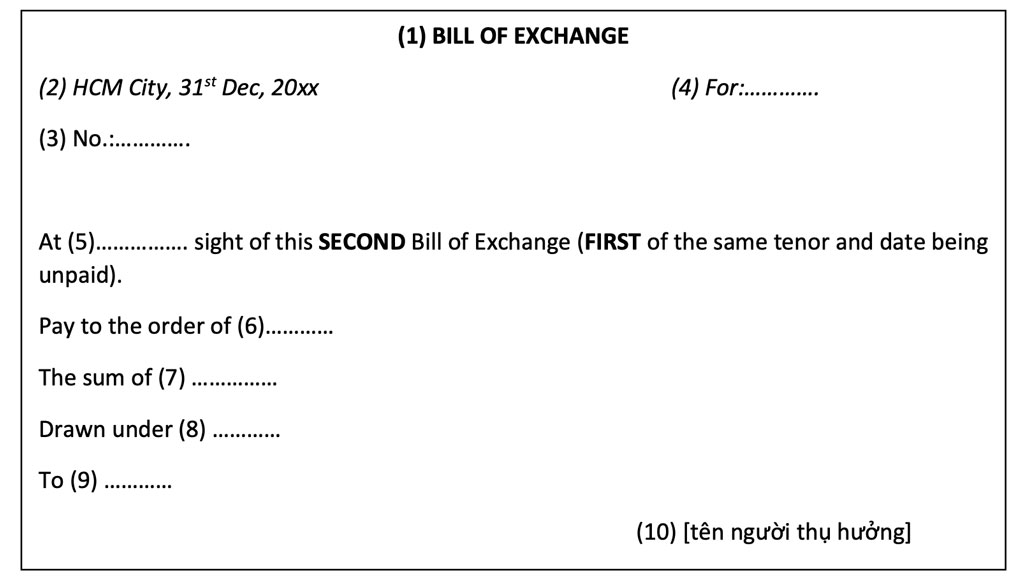
Before accepting the transfer, the transferee should verify mandatory contents of the bill, ensuring that it includes:
- The phrase “Bill of Exchange” on its face;
- An unconditional order to pay a specific sum of money;
- The time and place of payment;
- The name and address of the drawee;
- The name of the beneficiary or an order to pay the holder;
- The place and date of issuance;
- The name, address, and signature of the drawer.
The absence of any of the above contents may render the bill invalid, except for certain special cases stipulated in Clause 2, Article 16 of the Law on Negotiable Instruments 2005.
A lawful chain of transfer: Verification of the continuity and legality of prior transfers, ensuring there are no signs of forgery or alteration.
- Second, implementing a valid transfer
The transfer of a bill of exchange may be conducted as follows:
- Endorsement: The transferor signs on the bill and delivers it to the transferee. Endorsement must be unconditional; any attached conditions shall be null and void.
- Delivery: Applicable to bearer bills or bills that have been endorsed in blank.
Note that the transfer must cover the entire amount stated on the bill; partial transfers have no legal validity (Clause 1, Article 29).
- Third, presentment of the bill for acceptance and payment

The beneficiary is required to:
- Present the bill for acceptance: Where acceptance is required or where the maturity date is determined after a certain period from the date of acceptance, the beneficiary must present the bill for acceptance within one year from the date of issuance (Article 18).
- Present the bill for payment: Upon maturity, the beneficiary has the right to present the bill at the place of payment on the due date or within the following five working days (Clause 1, Article 43).
Presentment may be made directly or by registered mail; the date of presentment is determined by the postmark of the sending post office (Clause 3, Article 18).
- Fourth, handling cases of non-acceptance or non-payment
Where the bill is dishonored by non-acceptance or non-payment, the beneficiary has the right to:
- Performing recourse: Demanding payment from the drawer, prior endorsers, or guarantors (Article 48);
- Giving notice: Sending written notice of dishonor to relevant parties within four working days from the date of receipt of the notice of dishonor (Article 50);
- Initiating legal proceedings: Where the above measures prove ineffective, the beneficiary may initiate legal action in accordance with law.
- Fifth, preservation of rights through guarantee
The beneficiary may request a guarantee to enhance payment security. A guarantee is effected by the guarantor writing the term “guarantee”, the guaranteed amount, name, address, signature of the guarantor, and the name of the guaranteed party on the bill or an attached document (Article 25). The guarantor undertakes to pay all or part of the amount stated on the bill if the guaranteed party fails to perform the payment obligation.
5. Legal procedures required to ensure lawful ownership upon transfer
To ensure lawful ownership when receiving a transfer of a bill of exchange, the transferee should implement the following procedures:
- Fully verifying the contents of the bill in accordance with Article 16 of the Law on Negotiable Instruments 2005;
- Presenting the bill in compliance with Article 18 to request acceptance or payment;
- Where necessary, notarizing or authenticating the transfer to enhance its legal validity.
III. Common issues related to the transferee of a bill of exchange for payment demand
1. If the transferee further transfers the bill without verifying its legality, is legal liability incurred if the bill is found to be forged or invalid?
When transferring a bill of exchange, the transferor is responsible for ensuring the legality and validity of the bill. If the transferee further transfers the bill to a third party without verifying its legality, they may take legal liability if the bill is later discovered to be forged or invalid.
Specifically, pursuant to Point a, Clause 3, Article 29 of Decree No. 88/2019/ND-CP, transferring a negotiable instrument while knowing that it has matured, been dishonored by non-acceptance or non-payment, or been notified as lost may result in an administrative fine ranging from 30,000,000 VND to 50,000,000 VND.
In addition, under Article 208 of the Penal Code 2015, any person who forges negotiable instruments may be subject to imprisonment ranging from two (02) to seven (07) years.
2. If the issuer refuses to pay a lawfully transferred bill, does the transferee have the right to demand payment from the transferor?
Pursuant to Clause 1, Article 48 of the Law on Negotiable Instruments 2005, an endorser takes payment liability where the bill is dishonored by non-acceptance or non-payment, unless otherwise agreed. Accordingly, if a bill has been lawfully transferred but the issuer refuses to pay, the transferee has the right to demand payment from the transferor.

Furthermore, under Article 49 of the same Law, the transferee has the right of recourse against all parties liable on the bill, including prior endorsers, the drawer, or any guarantor (if any). To exercise such a right, the transferee must send a notice of dishonor within four (04) working days from receipt of the notice from the drawee, pursuant to Article 50. Failure to give timely notice does not extinguish the right of recourse, but the transferee must compensate for any damages arising from such delay. After giving notice, the transferee may present the bill and demand payment.
3. Where a bill has matured but the transferee does not receive any notice from the transferor or the issuer, does the transferee lose the right to claim payment?
Pursuant to Clause 1, Article 50 of the Law on Negotiable Instruments 2005, where a bill is dishonored by non-payment, the transferee is obliged to notify the transferor within four working days from the date of receiving notice from the drawee. However, if the transferee does not receive any notice from the transferor or the issuer, they retain the right to claim payment, although they may suffer losses due to failure to give timely notice.
Failure to provide notice within the prescribed time limit does not extinguish the right of recourse; however, the transferee shall be liable for damages arising from the delay in notification.
Accordingly, the transferee does not lose the right to demand payment. Nevertheless, if timely notice is not received and the transferee does not proactively verify the status of the bill, difficulties in exercising recourse or losses of rights and interests may arise.
IV. Legal consultancy services relating to the transferee of a bill of exchange for payment demand
To ensure that transactions involving the transfer of bills of exchange for payment demand are conducted in compliance with law and to mitigate potential legal risks, seeking professional legal consultancy services is essential. NPLaw provides comprehensive legal advisory services, ranging from contract drafting and clarification of applicable legal regulations to procedural support throughout implementation. Such comprehensive assistance helps save time and ensures the successful completion of transactions.












