Food safety and hygiene has become a matter of significant public concern in recent years. In fact, any business operation involving food products is required to satisfy food safety and hygiene conditions. In order to verify whether a business establishment meets food safety and hygiene requirements, a specific legal document is required, namely the Certificate of Eligibility for Food Safety. What is a Certificate of Eligibility for Food Safety, and what documents are required for its application? Let us explore procedures and dossiers for application for the Certificate of Eligibility for Food Safety in the following article.
I. How is the Certificate of Eligibility for Food Safety understood?
The Certificate of Eligibility for Food Safety is a document issued by a competent state authority to business households and establishments engaged in food production or food service activities.
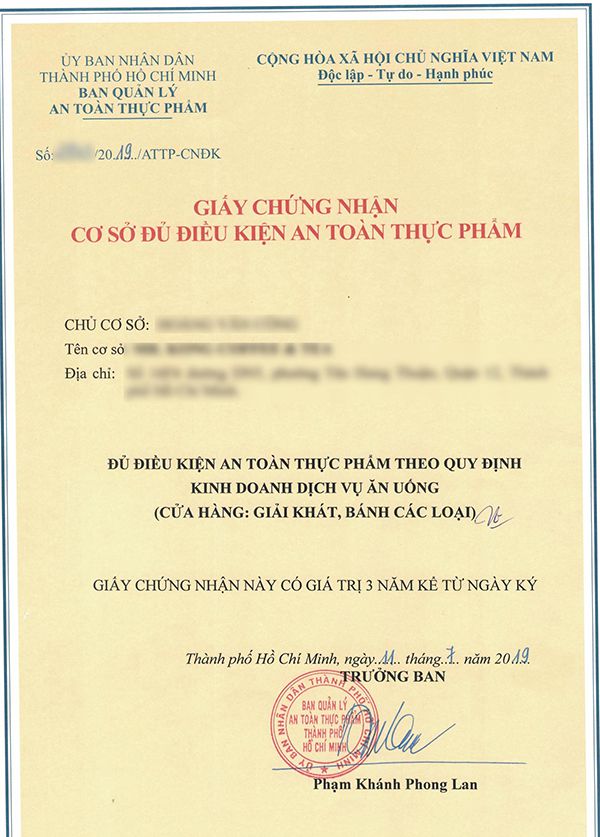
Such a certificate serves as legal confirmation that a particular establishment satisfies the statutory conditions for food safety and hygiene in conducting its business operations. It constitutes a mandatory requirement for enterprises, business households, and food production facilities to demonstrate their commitment to providing hygienic and safe food products to consumers.
II. Which business forms and entities are required to obtain a Certificate of Eligibility for Food Safety?
Vietnamese agencies, organizations, and individuals; foreign organizations and individuals operating in Vietnam who engage in food production and trading activities; and entities involved in food safety-related activities in Vietnam are required to obtain a Certificate of Eligibility for Food Safety, except for the following cases:
- Small-scale primary production;
- Food production and trading without a fixed business location;
- Small-scale preliminary processing;
- Small-scale food trading;
- Trading in pre-packaged food products;
- Production and trading of tools, packaging materials, and containers for food;
- Restaurants operating within hotels;
- Collective kitchens that are not registered for food business activities;
- Street food trading;
- Establishments that have been granted one of the following valid certifications: Good Manufacturing Practices (GMP), Hazard Analysis and Critical Control Points (HACCP), ISO 22000 Food Safety Management System, International Food Standard (IFS), British Retail Consortium (BRC) Global Standard for Food Safety, Food Safety System Certification (FSSC 22000), or equivalent certifications.
However, the above-mentioned establishments are still required to comply with applicable food safety conditions in accordance with relevant regulations.
III. Procedures for application for the Certificate
Application dossier includes:
- Enterprise Registration Certificate with registered food business lines;
- Written explanation of facilities, equipment, and tools ensuring food safety conditions;
- Certificate of food safety knowledge training for the establishment owner and individuals directly engaged in food production and trading;
- Health certificates of the establishment owner and individuals directly involved in food production and trading; laboratory test results confirming negative intestinal pathogens (including cholera, bacillary dysentery, and typhoid) for persons directly involved in food production in areas where diarrheal epidemics are declared by the Ministry of Health;
- Documents evidencing the origin of raw materials and food products; inspection results of water sources used, ice (if any), and equipment and utensils used at the food production and trading establishment.
Processing time: Approximately 15–20 working days from the date of submission of a complete and valid application dossier.

Licensing authority: The Sub-Department of Food Safety and Hygiene of provinces and centrally governed cities is responsible for issuing the Certificate of Eligibility for Food Safety to the following establishments:
- Food service establishments whose Enterprise Registration Certificates are issued by the Department of Planning and Investment of provinces and centrally governed cities;
- Food service establishments whose Enterprise Registration Certificates are issued by district-level People’s Committees (or competent authorities) with a business scale of 200 meal servings per service or more.
The district-level People’s Committees (or competent authorities) are responsible for issuing the Certificate to food service establishments whose Enterprise Registration Certificates are issued by district-level authorities and whose business scale is fewer than 200 meal servings per service.
IV. Importance of the Certificate of Eligibility for Food Safety for food production and trading establishments
All food production and trading establishments are required to obtain a Certificate of Eligibility for Food Safety from competent authorities. To be granted this certificate, food production establishments must fully satisfy hygiene conditions and be equipped with facilities and equipment that ensure food safety and hygiene standards.

The Certificate of Eligibility for Food Safety represents the assessment and approval by competent health authorities of food production and trading establishments with clear origins of raw materials and products, demonstrating that their food products meet food safety standards and are safe for consumer health.
In the current context where unsafe food products remain prevalent, the Certificate of Eligibility for Food Safety serves as a formal assurance of food hygiene and safety, and of consumer health protection, recognized by competent authorities. Therefore, such a certificate is of critical importance to all food production and trading establishments.
Failure to obtain a Certificate of Eligibility for Food Safety may result in administrative fines ranging from 20,000,000 VND to 60,000,000 VND, depending on the nature of the food business activities.
Furthermore, establishments that violate regulations on food safety conditions applicable to food products; food safety requirements in production, trading, and supply; food safety requirements for imported and exported food products; or other regulations related to food safety in food production, trading, and supply may be subject to administrative penalties depending on the specific violations committed.
To avoid unnecessary legal risks and violations, please contact NPLaw for professional consultation and guidance on procedures for application for the Certificate of Eligibility for Food Safety in the most efficient manner. With many years of experience and a proven track record in handling applications for Certificates of Eligibility for Food Safety, NPLaw is committed to providing reliable and effective legal support.