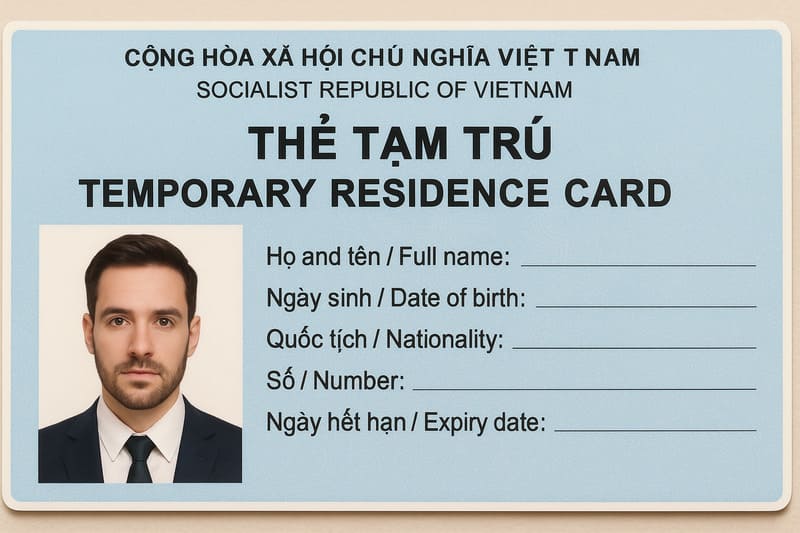
The rejection of applying for temporary residence cards for foreign people is a considerable legal issue in residence in Vietnam. Such rejection may arise from various reasons, such as incomplete documents, illegal accommodation, or violation of entry regulations. NPLaw invites readers to understand the legal issues related to the rejection of temporary residence cards for foreigners in the following article.
I. Current situation of the rejection of temporary residence cards for foreigners
Currently, when the number of foreigners living, working, and studying in Vietnam increases significantly, cases of rejecting temporary residence cards have become more frequent, especially in major cities such as Hanoi, Ho Chi Minh City, and Da Nang. The main reason is that foreigners reside at locations without ensuring legal conditions, such as illegally constructed houses, properties under dispute, or assets subject to revocation or demolition requirements.

In addition, many applications are rejected due to inaccurate information, documents without proving legal accommodation, or the landlord’s refusal to register the temporary residence. Moreover, some foreigners whose visas have expired or are no longer suitable for their intended residence purpose but still attempt to apply for temporary residence, they are consequently refused. Such situations reflect the increasing demand for temporary residence cards for foreigners but fail to comply with legal regulations among some foreigners and related parties, resulting in legal consequences and affecting lawful residence rights.
II. Rejection of temporary residence cards for foreigners?
1. Definition
Temporary residence for foreigners means a foreigner (a person without Vietnamese nationality) registers temporary residence at a specific address within Vietnam territory for a certain period according to Vietnamese law.
A rejection of temporary residence cards for foreigners arises when the competent authority (usually the immigration department) does not approve or issue a temporary residence certificate or card to a foreigner who applies to reside in Vietnam for a specified period.
2. Cases related to the rejection of temporary residence cards for foreigners
According to Articles 23 and 27 of the Law on Residence 2020, foreigners may be rejected temporary residence cards if they fail to meet the registration requirements, including specific cases such as:
- Residing at an illegal location outside the commune-level administrative unit.
- Staying for less than 30 days and not being subject to temporary residence registration.
- Residing in prohibited areas or others affecting security and safety of construction works.
- Residing in illegally constructed areas or encroached land.
- Residing in areas under land revocation orders or ongoing disputes.
- Residing in areas seized or facilities inappropriate for residence registration.
- Residing in areas under demolition orders.
3. Solutions when temporary residence cards are rejected
When temporary residence cards are rejected, the foreigners or the sponsoring organizations may take one of the following actions:
- Reviewing the reason for rejection, supplementing documents, or adjusting information to resubmit the application;
- Working directly with the residence registration authority for detailed guidance on legal requirements for each local;
- Filing a complaint or lawsuit if the rejection lacks legal basis;
- Moving to a legally valid residence (if rejection is due to an invalid location).
III. Legal regulations on the rejection of temporary residence cards for foreigners
1. Legal provisions for handling the rejection of temporary residence cards
Pursuant to Article 28 of the Law on Residence 2020, when a foreigner submits an application for temporary residence registration to the residence registration authority, the authority must receive, review, and verify the application. If the application is incomplete or invalid, or the applicant fails to meet regulated conditions, the competent authority may reject it. However, such rejection must be made in writing, clearly stating the reasons, ensuring transparency, and allowing the applicant to adjust or appeal if necessary.

Additionally, under Decision No. 320/QĐ-BC, if the application meets conditions but is incomplete, the authority must provide guidance to supplement and complete the application, including a “Supplementary Guidance Form” (Form CT05, issued together with Circular 66/2023/TT-BCA). If the application does not meet temporary residence requirements, the authority must reject and issue a “Rejection Form” (Form CT06, issued together with Circular 66/2023/TT-BCA).
2. Common reasons for the rejection of temporary residence cards
Frequent reasons for rejection include:
- Illegal accommodation: Located in areas prohibited, illegally constructed, encroached, under dispute, or subject to demolition (Article 23, Law on Residence).
- Incomplete or incorrect documents: Have wrong passport number, or lack signatures or proof of accommodation.
- Lack of consent: Not have the property owner’s agree.
- Misunderstanding purposes: Obtain unclear or incompatible residence purposes with the current visa.
3. Handling process after the rejection of temporary residence cards
According to Article 28 of the Law on Residence 2020 and Decision 320/QĐ-BC, when a temporary residence application is refused, the residence registration authority must notify the applicant in writing, stating the rejection reasons. Accordingly, after receiving the notice:
- If the application lacks documents or obtains false information, the foreigner may supplement, adjust, and resubmit immediately.
- If the application meets conditions but is incomplete, the authority provides guidance and issues a Supplementary Guidance Form (Form CT05, Circular 66/2023/TT-BCA).
- If the application does not meet conditions, the authority rejects it and issues a Rejection Form (Form CT06, Circular 66/2023/TT-BCA).
- If the foreigner disagrees with the rejection, they may file a complaint or lawsuit.
- During the period without temporary residence, staying may result in administrative sanctions or be considered illegal residence.
IV. Questions about the rejection of temporary residence cards for foreigners
1. What rights does a foreigner have if they disagree with the rejection?
Foreigners may:
- Request written explanation from the authority stating the rejection reason in accordance with Article 28 of the Law on Residence 2020;
- File a complaint with the same authority to reconsider;
- File a second complaint if the first result is still reasonable;
- Initiate administrative litigation at a competent People’s Court if the rejection is unlawful or affects lawful residence rights.
2. Can temporary residence cards be rejected based on financial reasons?
Vietnamese law does not regulate the rejection for temporary residence cards based on a foreigner’s financial status. However, in cases involving investment, work, or study visas, financial capacity may be assessed during visa issuance, not during local temporary residence registration.
3. If a foreigner has a valid visa but is rejected a temporary residence application, how are their rights affected?
If a foreigner with a valid visa but still is rejected temporary residence, it is allowed to stay in Vietnam for the visa duration, but such person will:

- Be prevented from legal residence registration, affecting renting, employment, opening bank accounts, or visa/temporary residence extensions in the future;
- Be responsible for administrative sanctions for unregistered or illegal residence;
- Be limited to administrative services related to residence.
4. Is it necessary to inform the foreigner of the rejection reason?
According to Article 28 of the Law on Residence 2020, the rejection must be in writing, clearly stating the reasons to allow the foreigner to correct deficiencies or appeal.
5. Is there a minimum period to resubmit an application after the rejection?
Minimum period isn’t legally required. Foreigners may resubmit immediately after completing or correcting the application to meet the authority’s requirements.
V. Why should it consult lawyers regarding the rejection of temporary residence cards for foreigners
The above article by NPLaw outlines the rejection of temporary residence cards for foreigners. NPLaw’s experienced lawyers and legal specialists are willing to provide guidance and support on all legal matters related to the rejection of temporary residence. For legal assistance, contact NPLaw directly.