Applying for temporary residence for employees of foreign companies is an essential administrative procedure that enables foreign workers to reside lawfully and stably in Vietnam during their employment. Such a procedure requires a thorough understanding of regulations on immigration, residence, and labor. The below article by NPLaw will clarify the significance, definition, legal provisions, conditions, dossier, and procedures for obtaining temporary residence for employees of foreign companies, while also addressing frequently asked questions on such matters. NPLaw provides professional legal consulting services to help both foreign workers and enterprises implement the application for temporary residence efficiently, conveniently, and with peace of mind.
I. Significance of temporary residence for employees of foreign companies in the current context
In the era of global integration, Vietnam increasingly attracts foreign companies and expatriate workers, particularly in industrial zones and major cities such as Hanoi, Ho Chi Minh City, and Binh Duong. Applying for temporary residence for employees of foreign companies not only ensures compliance with the law but also enables enterprises and workers to maintain stable operations. However, difficulties often arise due to lack of legal knowledge, incomplete dossiers, or failure to satisfy statutory conditions.
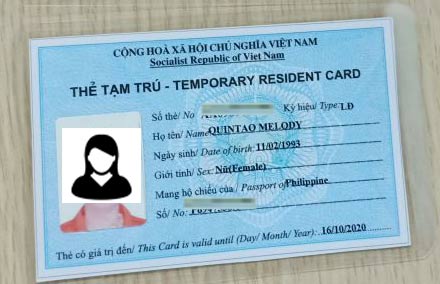
For example, in Ho Chi Minh City, Mr. John, an engineer working for a foreign company, was denied extension of his temporary residence card because his employer failed to provide a valid work permit and labor contract. As a result, he was forced to suspend work and took potential administrative sanctions. This case highlights the importance of preparing complete dossiers and following proper procedures for temporary residence to avoid work disruptions and legal risks.
II. Understanding of the application for temporary residence for employees of foreign companies?
1. Definition
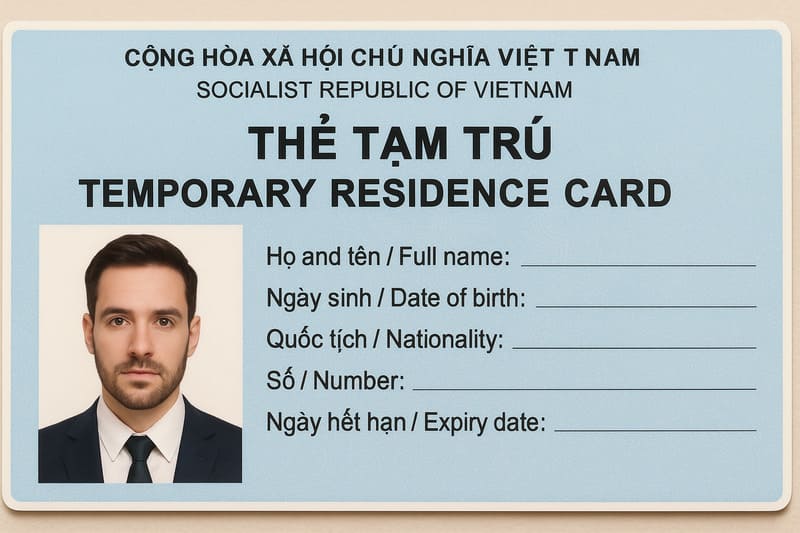
Temporary residence for employees of foreign companies is an administrative procedure under which foreign workers are granted visas or temporary residence cards permitting them to lawfully reside in Vietnam while working for a foreign company or a company with foreign investment.
Pursuant to Article 38 of the Law on Entry, Exit, Transit, and Residence of Foreigners in Vietnam 2014 (as amended in 2019), the validity of temporary residence cards is regulated as follows:
- Temporary residence visas with symbol ĐT1: up to 10 years.
- Temporary residence visas with symbols NG3, LV1, LV2, LS, ĐT2, DH: up to 5 years.
- Temporary residence visas with symbols NN1, NN2, ĐT3, TT: up to 3 years.
- Temporary residence visas with symbols LĐ1, LĐ2, PV1: up to 2 years.
- Always at least 30 days shorter than the passport validity.
- Expired cards may be considered for reissuance.
2. Why temporary residence is necessary for foreign workers
Temporary residence offers numerous benefits for both foreign workers and enterprises:
- Being lawful residence: It ensures foreign workers can legally reside and work in Vietnam, avoiding risks associated with unlawful stay.
- Facilitating transactions: Temporary residence cards are essential for civil, economic, and financial transactions in Vietnam (e.g., opening bank accounts, purchasing property, completing administrative procedures).
- Extending visa: Temporary residence is a prerequisite for work visa renewal.
- Demonstrating corporate compliance: By ensuring legal procedures for foreign workers, enterprises show professionalism, legal compliance, and enhance their reputation with partners and clients.
- Attracting and retaining talent: It creates favorable conditions for foreign workers to come, stay, and contribute long-term to the enterprise.
III. Legal provisions governing temporary residence for employees of foreign companies
1. Eligibility conditions
Under the Law on Entry, Exit, Transit, and Residence of Foreigners in Vietnam 2014 (as amended 2019) and Decree No. 152/2020/ND-CP, foreign workers must satisfy the following conditions to be granted temporary residence:
- Holding a valid passport or equivalent documents.
- Possessing a work permit or confirmation of exemption (except for cases exempted under the law).
- Providing documents evidencing lawful purpose of entry (e.g., labor contract, appointment decision).
- Not falling within the categories prohibited from entry (e.g., wanted persons, those with prior criminal convictions).
- Having a lawful permanent or temporary address in Vietnam.
2. Required documents
According to Clause 1, Article 37 of the Law on Entry, Exit, Transit, and Residence of Foreigners in Vietnam 2014 (amended 2019), the dossier for applying temporary residence includes:

- Written request for issuance of a temporary residence card (Form NA6 issued under Circular No. 04/2015/TT-BCA), submitted by the guarantor organization/employer.
- Application form with photo (Form NA8 issued under Circular No. 04/2015/TT-BCA).
- Passport.
- Proof of entry under labor visa category LĐ1, LĐ2.
3. Procedures for implementing temporary residence for employees of foreign companies
The procedure for obtaining temporary residence for foreign workers generally consists of the following steps:
- Preparation of dossier: The enterprise or the foreign worker prepares a complete dossier as prescribed.
- Submission of dossier: The enterprise or the foreign worker submits the dossier to the competent Immigration Authority (Immigration Department or Immigration Division of provincial police).
- Receipt and verification: The immigration authority receives and reviews the dossier for validity.
- Examination and verification: The authority examines the dossier and verifies information if necessary.
- Issuance: If the dossier is valid and conditions are met, the Immigration Authority issues the temporary residence card to the foreign worker.
IV. Questions on implementing temporary residence for employees of foreign companies
1. Can missing documents in the application be supplemented later?
The Immigration Authority will issue a notice requesting additional documents within a set timeframe. Supplementary steps include:
- Receiving a notice of missing documents.
- Preparing and submitting supplementary documents in originals or certified copies.
- Consulting a lawyer or service provider to ensure compliance.
2. What needs to be implemented if the application is rejected?
The Immigration Authority will issue a written notice stating reasons for rejection. The foreign worker may file a complaint under the Law on Complaints or prepare and resubmit the dossier after rectifying the deficiencies.
3. Can foreign employees apply for temporary residence under the investor category?
Typically, foreign employees apply under the labor category. Investors apply only to foreigners who are investors or shareholders in Vietnamese enterprises. If a worker is also an investor/shareholder, they may apply under the investor category, provided that they furnish investment documents (e.g., capital contribution certificate, business registration) and meet investment capital requirements under the Investment Law.
4. If a worker is reassigned to another location, can they obtain temporary residence there?
The worker must update residence information with the competent authority at the new location:

- Notifying the new address: Within 24 hours of relocation, the enterprise or foreign worker must notify the local police authority.
- Updating the temporary residence card dossier: Submitting supplementary documents (e.g., new residence confirmation, updated labor contract) to the Immigration Division of the local police.
- Renewing the temporary residence card if necessary: Applying for renewal with updated address details if the temporary residence card is about expiry.
5. Are there salary requirements for temporary residence applications?
Salaries must correspond to the worker’s qualifications and job position, comply with the regional minimum wage under the Labor Code, and meet position-specific requirements under Decree No. 152/2020/ND-CP. In some cases, immigration authorities may request proof of financial capacity (e.g., payroll records, contracts) to ensure the worker can sustain their living in Vietnam.
V. Should legal assistance be sought for temporary residence applications for employees of foreign companies?
Engaging a lawyer specializing in immigration, residence, and labor law is highly beneficial, especially for foreign workers and enterprises employing them, as lawyers can:
- Provide accurate, comprehensive legal guidance on temporary residence procedures.
- Ensure complete and compliant dossier preparation.
- Represent clients in dealings with State authorities.
- Resolve legal issues arising during the application process.
- Save time, costs, and effort for clients.
Contact NPLaw today for professional consultation and legal support to ensure that your temporary residence application is processed swiftly, smoothly, and in full compliance with the law.