In today’s dynamic economic environment, seals are not only legal symbols of enterprises but also important instruments in commercial transactions. The following article by NPLaw provides an overview of regulations on seal licensing and addresses common questions, helping enterprises better understand and properly comply with relevant legal requirements.
I. Role of seal licensing
Seal licensing plays an important role in the operation of enterprises. Specifically:
- Confirming legal status: A seal is a legal symbol of an enterprise and serves as evidence of its legal personality, ensuring legal validity in transactions and contracts.
- Building trust: The seal enhances the confidence of partners and customers in the legitimacy and credibility of the enterprise.
- Ensuring compliance with legal regulations: The use of seals without a licensing or in violation of regulations may lead to serious legal consequences, including contract invalidation or administrative sanctions.
II. Legal regulations on seal licensing
1. What is seal licensing?
Clause 12, Article 3 of Decree No. 99/2016/ND-CP (as amended by Clause 1, Article 2 of Decree No. 56/2023/ND-CP) provides:
- A Seal Specimen Registration Certificate is a document issued by the seal specimen registration authority certifying that an agency, organization, or state title holder has registered its seal specimen prior to use. It is issued in original or electronic form and has equivalent legal validity. Where requested by the agency, organization, or state title holder, both original and electronic versions shall be issued concurrently once the Public Service Portal and administrative procedure information system of the Ministry of Public Security are completed and put into operation.
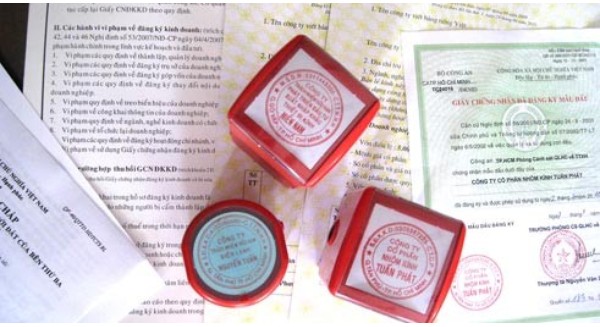
The Seal Specimen Registration Certificate is also understood as seal licensing. Such a document is issued by a competent authority to certify that an agency, organization, or state title holder has registered its seal specimen prior to use. It serves as the legal basis for the seal to take legal effect and to be lawfully used in business transactions.
2. Are newly established enterprises required to apply for seal licensing?
Under current regulations, enterprises are not required to apply for seal licensing upon establishment. However, enterprises still need to use seals on documents in transactions according to Clause 3, Article 43 of the Law on Enterprise 2020:
- The management and retention of seals shall be implemented in accordance with the company’s charter or internal regulations issued by the enterprise, branch, representative office, or other unit of the enterprise having a seal. Enterprises shall use seals in transactions in accordance with the law.
Accordingly, enterprises are advised to complete procedures relating to seals upon establishment to facilitate subsequent business operations in compliance with legal regulations.
3. What is the procedure for registration and issuance of seal licensing in Vietnam?
Pursuant to Article 11 of Decree No. 99/2016/ND-CP (as amended and supplemented by Clause 4, Article 2 of Decree No. 56/2023/ND-CP), the procedures for applying for seal licensing are as follows:
- Step 1: The agency, organization, or state title holder submits one (01) dossier requesting resolution of seal-related procedures to the seal specimen registration authority.
- Step 2: The receiving officer examines the validity of the dossier.
+ If the dossier is valid: A receipt is issued.
+ If the dossier is incomplete: Notification and guidance are provided for completion.
+ If the dossier does not meet the conditions: A written response is issued, refusing to process the application. - Step 3: Receipt of the processing result.
III. Certain questions regarding seal licensing
1. Can procedures for applying for seal licensing be authorized to a third party?
Pursuant to Clause 3, Article 11 of Decree No. 99/2016/ND-CP (as amended by Clause 3, Article 2 of Decree No. 56/2023/ND-CP):
- The person appointed by an agency, organization, or state title holder to submit dossiers as prescribed in Articles 13 and 14 and Clause 1, Article 16 of this Decree must have a letter of introduction or power of attorney.

Accordingly, organizations and individuals may authorize a third party to implement procedures for seal specimen registration in accordance with the above provisions.
2. How long does it take to obtain seal licensing, and is expedited processing available?
Pursuant to Clause 7, Article 11 of Decree No. 99/2016/ND-CP (Clause 8 added by Clause 4, Article 2 of Decree No. 56/2023/ND-CP):
- Within three (03) working days from the date of receipt of a valid dossier, the seal specimen registration authority shall return the results of registration of new seal specimens, re-registration of seal specimens, registration of additional seals, registration of embossed seals, reduced-size seals, wax seals; and issuance, exchange, or re-issuance of seal specimen registration certificates.
Accordingly, the duration for issuance of seal licensing is three (03) working days from the date of receipt of a valid dossier.
3. If the seal contains incorrect information compared to the licensing, may the enterprise amend or apply for re-issuance?
Article 17 of Decree No. 99/2016/ND-CP (supplemented by Point b, Clause 6, Article 2 of Decree No. 56/2023/ND-CP) provides on dossiers for exchange or re-issuance of seal licensing:
- A written request for exchange or re-issuance of the seal licensing by the agency, organization, or state title holder using the seal, specifying the reasons, and the person appointed to submit the dossier.
Accordingly, organizations and individuals may request re-issuance of the seal licensing and submit dossiers in accordance with the above regulations.
4. Is it mandatory to carry the seal licensing when using the seal?
Clause 5, Article 24 of Decree No. 99/2016/ND-CP on responsibilities of agencies, organizations, and individuals using seals provides:
- Seals must be strictly managed at the headquarters of the agency or organization; only state title holders or heads of agencies or organizations are entitled to decide on bringing seals out of the headquarters for use in handling official matters.
Accordingly, seals must be strictly managed at the headquarters of the agency or organization, and only the head thereof may decide on taking the seal outside for official use.
5. If an enterprise has multiple branches, does each branch need separate seal licensing?
Clause 2, Article 43 of the Law on Enterprises 2020 provides:
- Enterprises shall decide on the type, quantity, form, and contents of seals of the enterprise, its branches, representative offices, and other units.
In addition, there are currently no regulations mandating that enterprise branches must have separate seals. Therefore, If an enterprise has multiple branches, whether to make separate seals and apply for separate seal licensing for branches is at the discretion of the enterprise.
6. When an enterprise changes information on the seal (e.g., change of address or enterprise name), must the seal licensing be changed accordingly?
Pursuant to Clause 9, Article 24 of Decree No. 99/2016/ND-CP on responsibilities of agencies, organizations, and individuals using seals:
- Where a seal in use is deformed, worn, damaged, or where there is a change in organization or name, procedures for re-registration of the seal specimen must be implemented, and the previously issued seal and seal licensing must be returned to the seal specimen registration authority.

Accordingly, where there is any change to the information on the seal, enterprises are required to implement procedures for re-registration of the seal specimen in accordance with the above regulations.
IV. Legal consulting services on seal licensing
The above is NPLaw’s article on current regulations regarding seal licensing. With a team of experienced lawyers and legal specialists, NPLaw provides reputable and professional legal services to best safeguard the lawful rights and interests of clients. Should you require legal assistance, please contact NPLaw for consultation and support.